We arrived in Hanoi in the early evening, checked into our hotel, and immediately set off to get some Bun Cha (noodles with pork) and spring rolls. Bun Cha is one of the many foods that Hanoi is famous for. My immediate reaction to Hanoi was that I was glad that I am living in Saigon for the semester. Hanoi is wonderful in its own way, though by contrasting the two, Hanoi feels older and less metropolitan, while still feeling more westernized at the same time. During our trip to the northern regions, I somewhat wish that I could have had maybe one more extra day to explore Hanoi because I feel that my experience of it may not have been as integrative as I would have hoped. Don’t get me wrong, I enjoyed my time there, I just don’t feel as if I was able to see Hanoi for the wonderful city that it is. Hanoi is the capital of Vietnam, and so it is home to many more historical sites than in Saigon. I guess you could say that Hanoi is like the east coast of America, and Saigon is like the west coast. During the French colonization of Vietnam, there was more of a focus on northern Vietnam, and this is very apparent in the architecture and variety of shops and restaurants in Hanoi. Also the communist government is stronger in the north, and so the nightlife (and pretty much all other businesses) are required to close up shop at midnight every night. This fact was mind blowing, the last night we were in Hanoi when we finally made it out to the bars. At 11:30pm, the streets would be packed with partiers, and then by 12:05, Hanoi could have been equated to a ghost town. People in Hanoi are also less friendly than those in Saigon. When we spoke Vietnamese to them, they didn’t smile excitedly the way that they usually do in the south. It also didn’t help that Northern Vietnamese speak in a slightly different dialect than in the south, and so they understood us even less than they already do in Saigon. The motorbike problem in Hanoi also seemed to be worse. There was less honking, as honking is actually considered to be illegal in Hanoi, though this still didn’t stop people from honking at all, but the roads are narrower, and the sidewalks are more crowded by parked motorbikes and restaurants extending their tables outside than in Saigon. This made it so that most of the time, we almost had to walk down the middle of the street in order to get anywhere. 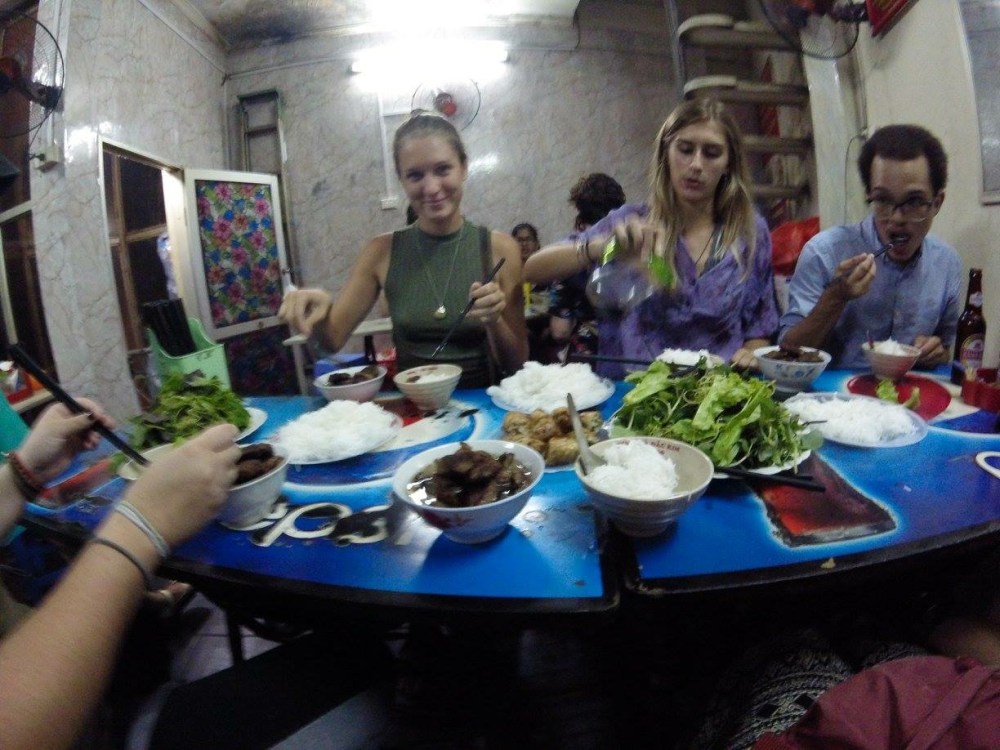 Pictured: Eating Bun Cha in Hanoi.
Our first day in Hanoi, we set off to see all of the aforementioned historical stuff throughout the city. We started out at Ho Chi Minh’s mausoleum. Usually, Ho Chi Minh’s body is embalmed inside of the mausoleum, and you can usually go inside to look at it, but currently it is in Russia for “maintenance” so we only saw the mausoleum from the outside. Even so the structure is impressive. It was modeled after Lenin’s mausoleum since Ho Chi Minh was the communist leader in Vietnam. We also were able to witness the changing of the guard, which was pretty cool. Fun fact: prior to his death, Ho Chi Minh had requested to be cremated, and for his ashes to be scattered in different parts of Vietnam. His wishes were ignored though, and the mausoleum was still built.  Pictured: Our group in front of the mausoleum.
After the mausoleum, we headed over to the President’s Palace and grounds. This is where the president of the communist party traditionally lives. The palace is huge and yellow to signify the color of the communist party, and the grounds are what used to be the Hanoi botanical garden, so they are full of many different kinds of trees and plants. Because of Ho Chi Minh’s humble demeanor, he preferred to live in a smaller “stilt house” on the edge of the grounds. Unlike the White House in Washington D.C., the grounds of the Yellow House can be accessed by the public with the purpose of a ticket, though the Yellow House itself cannot be closely approached. The grounds are also home to the oldest pagoda in the country of Vietnam.


Pictured: The Yellow House, Ho Chi Minh’s bedroom in the stilt house, and the Pagoda.
From the President’s Palace, we headed over to the Temple of Literature, built in 1070 by Emperor Ly Thahn Tong. This Temple is very close to the Vietnamese hearts as the temple that celebrates confucian learning and egalitarianism. It is also the temple that is pictured on the back of the 100,000d note.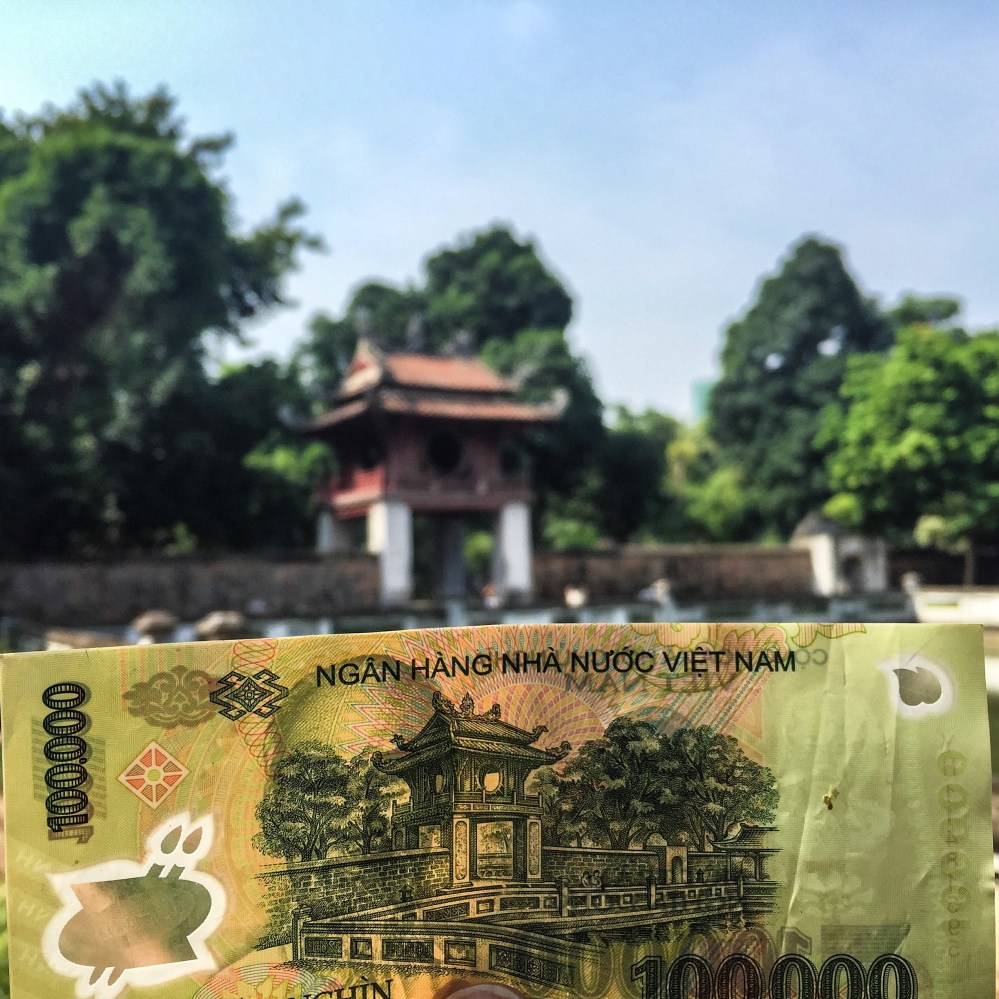 Pictured: the 100,000d note pictured in front of the Temple of Literature, Hanoi.
That evening, in Hanoi, we attended a traditional Vietnamese water puppet show. It was actually a lot more entertaining than I had expected. Accompanied by musicians and singers, the puppeteers stand behind a curtain, waist deep in water, and use puppets attached to sticks on the front side of the curtain to move the puppets through the water in a strangely realistic way. Though I had no idea what was being said, or what story was being told, the movement of the puppets and the music was beautiful to watch.  Pictured: Vietnamese water puppet show.
We ended the night by going out for some of the best pizza I have ever had. If you are ever in Vietnam, and are craving something western, I strongly suggest 4P’s Pizza. There is also one in Ho Chi Minh City, though I had never been before, so going in Hanoi was my first time. We were thinking about going out for some beers afterward, but we were way too stuffed from the pizza, so we called it a night (insert sleeping emoji here).
The next morning, we hopped on our bus for the four hour bus ride to Ha Long Bay. Ha Long Bay is one of the reasons that I chose to come to Vietnam for my semester abroad, and so I was SO excited. Loyola had booked a four hour boat cruise through the bay for us, and we completely lucked out with the weather. As we sat on the boat heading out into the bay, the tour served us some lunch. The food was average, but the view wasn’t. Ha Long Bay has been listed as one of the new natural wonders of the world, though the bay itself isn’t new at all. After lunch, we were able to go up to the roof of the boat to fully take in the views. The farther we got into Ha Long Bay, the larger and more prominent the limestone mountains loomed out of the water all around us. It was completely breathtaking. We also were able to get off the boat to go kayaking through a portion of the bay where the limestone islands have inner caverns and openings. Pictures in no way can do this place justice, so I suggest traveling to Vietnam to see for yourself. We completely lucked out with the weather as well, our group leaders commented on the fact that it was the clearest day they had ever experienced on the bay. I wish that we could have stayed on the bay longer, but all good things must come to an end, and after four hours, we had to get back on our bus to head back to Hanoi.


Pictured: Various photos of Ha Long Bay.
Ha Long Bay was the official last day of our group trip with Loyola, but the majority of our group opted to head up to Sa Pa for the weekend, because, why not? The bus ride to Sa Pa was six hours long, and so Loyola booked a sleeper bus for us. This was my first time on a sleeper bus, and it was definitely an experience (I will touch more on this later). Luckily, because the seats were in a horizontal position, it was pretty easy to sleep for much of the ride. Six hours later, we arrived in Sa Pa. The second we got off the bus, we were approached by about ten of the local hmong people, all wanting to offer us tours or hotels. It was very overwhelming, but as we had already booked our hotel, we were able to break away from the throng. Known for its mountains, and its voluminous rice paddys placed throughout the mountains and valleys, Sa Pa is breathtakingly beautiful. I have been to a lot of beautiful places in my lifetime, and Sa Pa has moved its way to a high place on the list.
After grabbing a quick bite to eat, a group of us headed to Cat Cat Village, to get an idea of what we were dealing with for the weekend. Just like most places in Southeast Asia, Sa Pa is a touristy place due to its vast beauty, and Cat Cat Village is probably the most touristy thing about it. The thing that I did like about the tourism in Sa Pa though, was that Sa Pa attracts a certain kind of tourist, the kind that enjoys the outdoors and culture, more so than the annoying kind of tourist that has no idea what they are doing. To get into Cat Cat village, one must walk down a winding road with wonderful views. It costs 50,000d (about $2.25) to get into the village, and then of course, much of the village is set up with shops where the Hmong people are trying to sell their homemade goods. Honestly, Cat Cat village isn’t much of a village from a tourist’s perspective, it is more of a tourist trap that offers a slight glimpse into Hmong culture. It really is just a walkway through a bunch of shops set up, that leads to Cat Cat waterfall, so when visiting Sa Pa, if you are truly wanting to see how the Hmong people traditionally live, Cat Cat is not your answer. It is a great place though to pick up some souvenirs, and to see the waterfall.


Pictured: Cat Cat waterfall, selling of wares, and the view above Cat Cat Village.
When planning our time in Sa Pa, we originally had not planned on hiring a guide to take us trekking, partially because we are cheap college students, and partially because there is some dispute about “ecotourism” and whether you are actually doing the people good by hiring them as tour guides. I had talked to some friends who had visited Sa Pa before though, and they had told me that hiring the tour guide is what made their trip worthwhile. Earlier in the day, before Cat Cat village, a Hmong woman had approached us on the street, wanting to be our tour guide. She told us that it would be $10 per person, and she could take us trekking through the mountains, and show us her village. After much debate, we decided to do it, and I am very happy that we did.
At 8:30am the next morning, Duong, our tour guide, met us at the hotel. From there, we set off in the same direction that we had the previous day, toward Cat Cat village, though we turned off the road before we got there. We started down a trail into the mountains, and I was immediately on cloud nine. This was the closest thing to Hawaii hiking that I have ever experienced, and it was wonderful. The trail was rough, and the foliage was green, and views of the mountains and rice paddys were everywhere. A couple young Hmong girls also accompanied us with Duong on the hike, and they were eager to help us with river crossings, though they loved to laugh whenever we would slip. We hiked along this trail for a few miles, stopping several times to take in the views. Though Duong and the younger girls were in sandals, they were incredibly agile, and kept the pace up the whole way. I am not sure how far we hiked during this beginning part, but in total throughout the day, we hiked 11.5 miles, and it was a good chunk of the hike.


Pictured: Hiking through the mountains and rice paddys, some views, and our trekking group with Duong and the girls.
When we got to the end of the mountainous part of our trek, we descended down a dirt road into the Lao Chai Village. Of course, as soon as we got to the bottom, we were approached by locals, most of them young children, asking us to buy things. This was the only downer of the trip, but it was to be expected. Most of us ended up buying something because it is almost impossible to say no. Duong had explained to us that Hmong people are not allowed to get jobs in the town of Sa Pa (working at hotels, restaurants, etc.) and so the only way for them to make money is by selling handmade things or giving tours. Traditionally, the men stay in the village and farm, or build houses, and so the women are expected to make money for the family. This is where that hard line between whether as tourists, we are helping the locals, or hurting them comes into play. On one hand, it helps them to buy things because they need the money, but it also encourages them, especially the children, to spend time selling things instead of in school. We only had to hope that the money we were spending both on souvenirs, and on our tour, that the money we were spending actually is going toward the schooling of Duong’s seven children, like she told us.
Lunch was included in our tour, so Duong sat us down at a restaurant, where we were fed fried rice and noodles. After lunch, we set off deeper into Duong’s village. She walked us through the streets, and through the fields. She showed us the church and the school house. It was interesting to learn that the Hmong people of the Lao Chai village attend catholic church. Duong didn’t seem to know when or how Catholicism began with the Hmong, but I can only imagine that it was brought over by the French. The highlight of the day for me, was when she took us to her own home. We walked about ten minutes up a very strenuously steep hill until we arrived at her house. She gladly showed us the inside of her house. Though it was about as minimalist as any American can imagine. It had one room, with a loft creating a second floor which was about half the size of the room. The loft was used for holding the family’s storage of rice. There was A LOT of rice up there. Duong explained to us, that her family was usually very lucky with growing rice, and often ended up sharing some of their store with her sister-in-law’s family. Below the loft were two full size beds, where I assume the whole family sleeps every night, and then the open part of the main room remained empty. On the walls were numerous pictures framed of family members. She pointed each one out to us, explaining who each of them are. Accompanying these photos were a couple framed photographs of her grandfather wearing a communist soldier’s uniform. It seemed to be some sort of award. Though the house was minimal, Duong showed us all of this with incredible pride and love for her life. It was one of the most amazing experiences I have had so far in Vietnam.
After showing us the inside of her house, she asked if it would be okay with us if she fed her baby really quickly. We waited outside while she did so, and played with her five daughters. They were so adorable and excited to see us. They teased each other like any siblings do, and showed off their rope game skills to us. We were very sad to leave them.


On our last walk through the village, Duong stopped at multiple places to show us how the Hmong make their art. She showed us the hemp plants that they use to make rope and clothing, and the indigo dye that they are famous for. We learned that the indigo dye is made by soaking the indigo leaves in water mixed with fire ants. The venom from the fire ants is what makes the dye stick to the cloth. How on earth did anybody ever figure that one out?  Pictured: Hemp plant.
As we came to the end of our journey with Duong, she gave us each golden (actually made from copper, she was quick to tell us as she was very adamant about the fact that, though Vietnamese people may lie to you about the quality of the goods that they sell, Hmong are not liars) bracelets, and told us that we were all friends now. She also asked me to tell my friends about her if they happen to be heading to Sa Pa. If anybody reading this plans on ever going to Sa Pa, give Duong a call. She is amazing. Her number is 01648882538. At the end of the tour, she had arranged for us to take motorbikes back up to Sa Pa, and so we sadly bid farewell to her, boarded onto the backs of our bikes, and headed up the 8km back toward Sa Pa. The road was windy and bumpy, yet very beautiful. So ended the my favorite day in Asia so far. When looking into the question of whether or not these tours are ethical or non-ethical, I think it really depends on perspective, and what one takes out of the experience. One can look at it from the perspective of “you are not seeing the real culture of the people because tourism and colonialism have destroyed their real culture, and you are just encouraging these cultural changes by spending money and going on the tours” or, one can look at it from the perspective of having a completely open mind, that really just wants to see the landscapes of Sa Pa, and experience the culture for what it is. Ultimately, almost everything in Southeast Asia, actually, everything in the world, can be looked at from various perspectives, and these questions will always come into play, and it is impossible to not experience some things without having these issues bother you, but when it comes down to it, everything in life is about one’s perspective, and as long as the awareness is there, all you can do is to try to experience as much as you can so as to gain knowledge about the world around you.


Pictured: motorbike ride up the mountain, Me and Duong at the end of our tour.
Anyway, we ended the day by hitting up “Why Not Bar” and having a couple of drinks before heading to bed. The whole day was the perfect way for us to end our two weeks of travel throughout the country. The next day, we were scheduled to take the sleeper bus back to Hanoi at 4pm, so we spent the day in coffee shops, catching up on some homework and photo uploading. I can honestly say that I fell in love with Sa Pa, and that it is by far my favorite place that I have visited so far this semester (though I may be a little bit biased because I love mountains so much).
 Michaela Rabinov
Sa Pa has been your favorite place so far and this posting has been my favorite posting so far, though all of them have been fascinating! I love your description of visiting Duong’s house, getting to know her and her family, and playing with her children and I love the perspective you have developed.
Love you!
Mom
LikeLike